



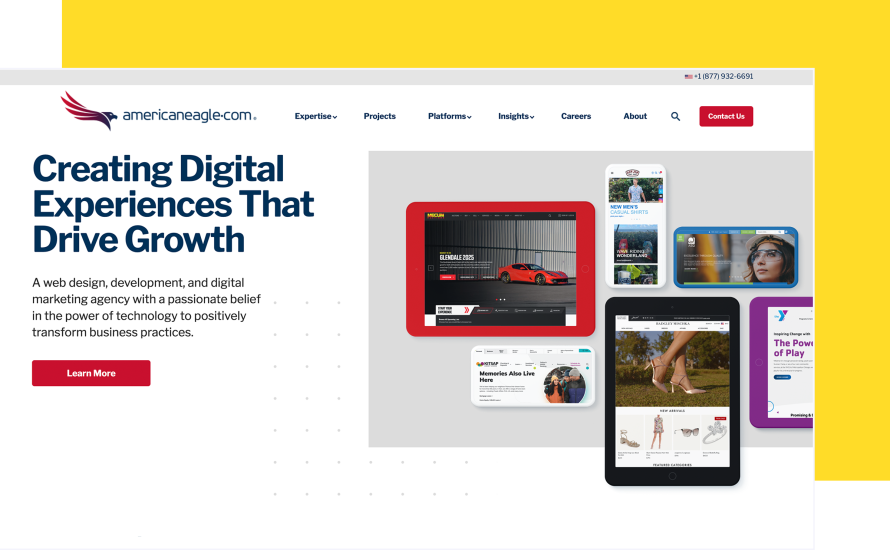
For three decades, Americaneagle.com has delivered web design, development, hosting, post-launch support, and digital marketing—building modern websites, integrated ecommerce solutions, mobile apps, and more. Their teams are platform experts, and clients like Dixon, an industrial coupling manufacturer, call on them to maximize their tech stack and produce measurable, on-target results.
Inside that practice sits Daniel Kinney, a 20-year Drupal architect; Sasha Gryshchuk, a 10-year React developer; and a long-running partnership with Pantheon. When those three forces lined up around a single complex e-commerce rebuild, the result changed how the agency ships every Drupal site they touch.
This is the story of how Americaneagle.com used Pantheon’s Next.js and Drupal backend to rebuild an underperforming client site with a headless architecture and rewrote their own deployment philosophy along the way.
Pantheon is a strong option for Drupal hosting, with deep specialization in the platform and a focus on delivering high-quality hosting performance. Their pricing is competitive, and they concentrate on doing hosting exceptionally well rather than spreading across too many areas. For Drupal-specific needs, Pantheon is often a go-to choice."
— Daniel Kinney, Drupal Architect, Americaneagle.com
Challenge: A Drupal Site in Disarray
Image
When Americaneagle.com inherited their client’s site, Dixon, from a previous agency, the solutions were struggling. The site was on a self-managed DigitalOcean stack. It was behind on security patches. It couldn't reliably stand up to everyday traffic, let alone the constant pressure of bots crawling the Solr search server. That bot traffic was bleeding through and degrading the experience for authenticated shoppers.
The problem was architectural. A single monolithic stack means every request—authenticated shoppers, anonymous browsers, bot crawlers, search indexers—all hit the same backend. When the bots show up at scale, real customers feel it. The site that was supposed to drive revenue starts costing it.
Daniel Kinney, Americaneagle.com's Drupal Architect and a self-described "hardcore Pantheon fanboy" since meeting founder Josh Koenig at DrupalCon Austin in 2014, knew exactly where Dixon's site belonged: back on Pantheon.
Approach: Headless from the Ground Up
After evaluating ROC Commerce, Oro, BigCommerce, and even a fully custom .NET solution, the Americaneagle.com team landed on an architecture that played to everyone's strengths: keep Drupal 11 as the backend (Dixon already loved working with it) and build a completely custom Next.js storefront on top.
At Americaneagle.com, we have platforms serving multiple clients, each with their own UI. Headless gives us the flexibility to make everything customizable—not just text, but the entire frontend."
— Sasha Gryshchuk, Senior Frontend Developer, Americaneagle.com
The timing was right. Two weeks after the official project kickoff with Dixon, Kinney got an invite to the Pantheon’s frontend beta program for Next.js hosting. The team joined immediately, kicked the tires, and set up the entire frontend project on the beta platform. By the time frontend sites became generally available, Americaneagle.com was already deep into production-grade development.
For Gryshchuk, Americaneagle.com's senior frontend developer and a 10-year React veteran, the headless approach unlocked a way of working she'd been chasing for years. "We're fully divided now. I'm not dependent on backend work. I can mock all the responses and build the product detail page exactly the way it should be—split into multiple endpoints, optimized for performance from day one. Once the backend is ready, I just remove the mocks. That's it. It saves us so much time, and it lets us think about performance as early as possible—not as a cleanup task at the end."
The downstream effects show up everywhere. Unauthenticated traffic never touches the backend where passwords and customer data live. Bot crawlers can't degrade the experience for authenticated shoppers. Clients see a polished, working frontend long before the backend integration is finished—without smoke and mirrors. And the team can put frontend specialists on the project without requiring them to also be Drupal experts. Kinney adds "In traditional Drupal, that was never possible. You needed someone intimately familiar with Drupal as well as the design and frontend side. With this separation, we can introduce an entire slice of expertise into the project—people who can focus on what they do best—without having to train them up on Drupal."
Then came the pipeline. Every pull request automatically spins up a Pantheon Multidev instance—a live, reviewable environment tied to that PR. Reviewers get a link in the ticket. QA hits it from a real device. PMs click through it. Gryshchuk's team layered CI/CD performance gates on top: when a Pantheon deployment finishes, an automated check runs performance tests against the PR URL. If a change tanks the metrics, the PR gets rejected before it can merge.
It worked so well that Americaneagle.com got jealous of their own pipeline. Kinney continues, "The Next.js Multidev deployment pipeline inspired changes across every one of our Drupal Pantheon-hosted site pipelines. We essentially got jealous of how effective and easy that workflow is, so we integrated it everywhere. Now anytime we make a GitHub or GitLab merge request on any of our Drupal sites, it's automatically spinning up Multidev environments using Quicksilver hooks. We rebuilt our whole deployment philosophy around it."
Results: From Stalled to Shipping
The architecture flipped the development paradigm. In a traditional Drupal build, the backend has to be largely finished before the frontend can start dressing it up. With headless, Americaneagle.com builds the frontend as it should exist—what Daniel calls "building it like it's magic"—and the backend meets it in the middle.
The proof-of-progress effect is impossible to overstate. Clients see a polished, working storefront in weeks, not months. The team can demonstrate decisions early. Trust compounds.
We've been able to demonstrate progress and show how the decisions we've made are—I can only call it magic. It's insane how vast the change has been at every facet of the project, and in the interaction with Dixon."
— Daniel Kinney, Drupal Architect, Americaneagle.com
Compared to self-hosting or more generalized modern hosting stacks, the Pantheon advantage came down to what doesn't have to happen.
With a self-managed stack, we could do everything, but we'd have to handle it ourselves. We'd need GitHub Actions to manage deployments. We'd need to build the multi-environment setup. We'd need to support it. With Pantheon, we did nothing. It just works out of the box. The cache handler for Next.js is right there. I can clear the cache from one place. It's amazing."
— Sasha Gryshchuk, Senior Frontend Developer, Americaneagle.com
And then there's reliability, measured not in SLA documents but in what happens on the bad days. When a major Cloudflare outage took down a wide swath of the internet, Americaneagle.com clients on Pantheon's Advanced Global CDN stayed up. Kinney adds, "All of our Pantheon sites did not go out, because they're on Advanced Global CDN. I don't recall ever seeing a client-facing incident on Pantheon. Pantheon stands out for many reasons."
What's Next
Dixon’s headless site is targeted to go live in October 2026. Americaneagle.com is already collecting strong numbers in lower environments and expects the live results to be even better.
For peer agencies asking whether they should run Next.js on Pantheon, Americaneagle.com said this:
Absolutely. It streamlines what has traditionally been a complex process, from pipeline management through review and deployment. With Pantheon, much of that is handled out of the box, which reduces operational overhead over time. It also helps present a more professional setup to clients from day one, which can help build trust early in the engagement."
— Daniel Kinney, Drupal Architect, Americaneagle.com

